Scope:
Celestron 9.25 Edge HD 235 mm at f/7;
Location: DAA Observatory, Shelter
Valley, CA;
Dates:
22, 23, 26, 27 June, 2025;
Camera:
ASI294MM (Baader LRGB Filters);
Exposure:
19.267 hrs
RGB -
54 x 2 min (gain-121 2x2) each RGB exposures.,
Lum - 208
x 4 min (gain-121 2x2)
Processing:
Data
Collection - N.I.N.A. Sequencer (as FITs). Sub-frame calibration -
Pixinsight (WBPP).
Sub-frame registration and integration (Average combine
- Linear clipping) - PixInsight (WBPP).
Noise reduction - NoiseXTerminator - PixInsight.
Non-linear
stretching, normalization and gradient removal - PixInsight.
RGB
Combination - PixInsight
Photometric
RGB calibration (SPCC) - PixInsight.
Deconvolution
of Lum and RGB stacks (RGB combine) - BlurXTerminator.
Generation
of starless nebulosity Lum and RGB images for later processing
- StarXTerminator.
Curves,
Levels stretch- PixInsight.
RGB Stars and starless combine -
Affinity Photo
Final
finishing - Affinity Photo.
Annotation
- PixInsight, Aladin (Simbad ), and Affinity Photo.
This
image is a broad band LRGB image processed at 5644x8288 resolution (2x
drizzle).
Final
Image size is approximately 4370x6418.
Description:
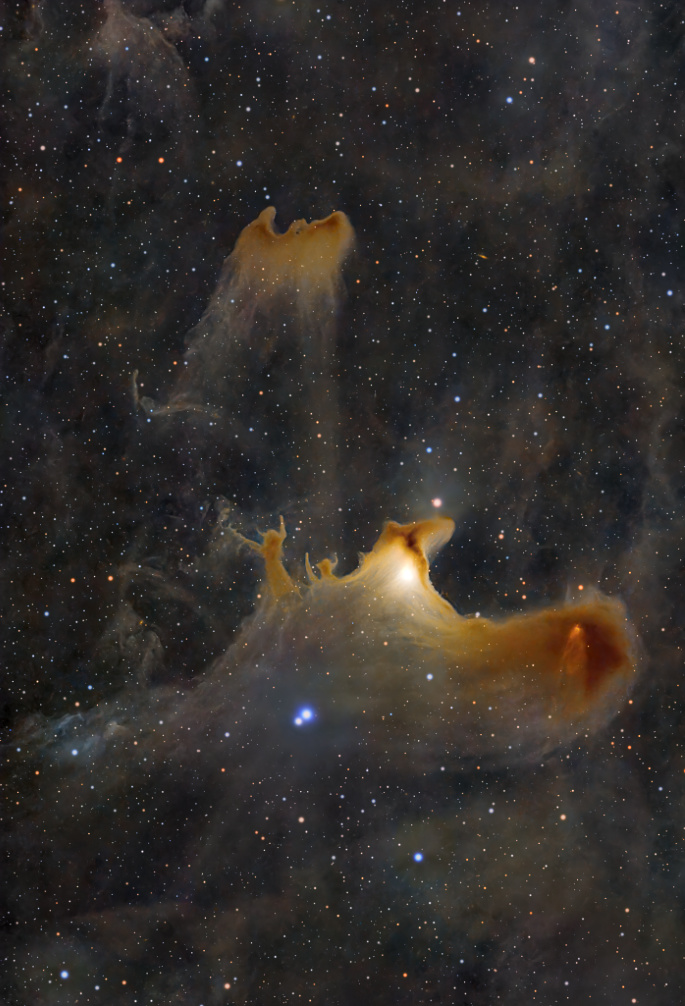
North is down in this image. This
image is a close-up of an interesting region near the well known Iris Nebula.
The orientation shows vdB 141 / Sh2-136 - the brightest portion about one third
from the bottom. This structure is commonly called the 'Ghost Nebula'. These
objects are about 1,300 to 1,500 light years distant.
Yellow and brown
tones result from the reflection of light of nearby and embedded stars off the
thick dense clouds of cosmic dust. Shapes and filaments are caused by
newborn protostars inside the cloud (sometimes called Young Stellar Objects -
YSO's).
The cometary like
object surrounded by a larger dark area toward the right is formed by a Bok
Globule (a small, dense cold cloud) - designated CB 230. The larger dark area
surrounding CB 230 is
LDN 1177 - a generally classed dark nebula). Protostars (YSO's) within the
Globule cause these cometary jets.
The upper third of
the image is another dense dust region. It is associated with the dense cold
cloud PGCC G104.85+13.13. This cold cloud is detected in sub mm and near IR
wavelengths. It appears in this optical wavelength image as a dense dusty
region.