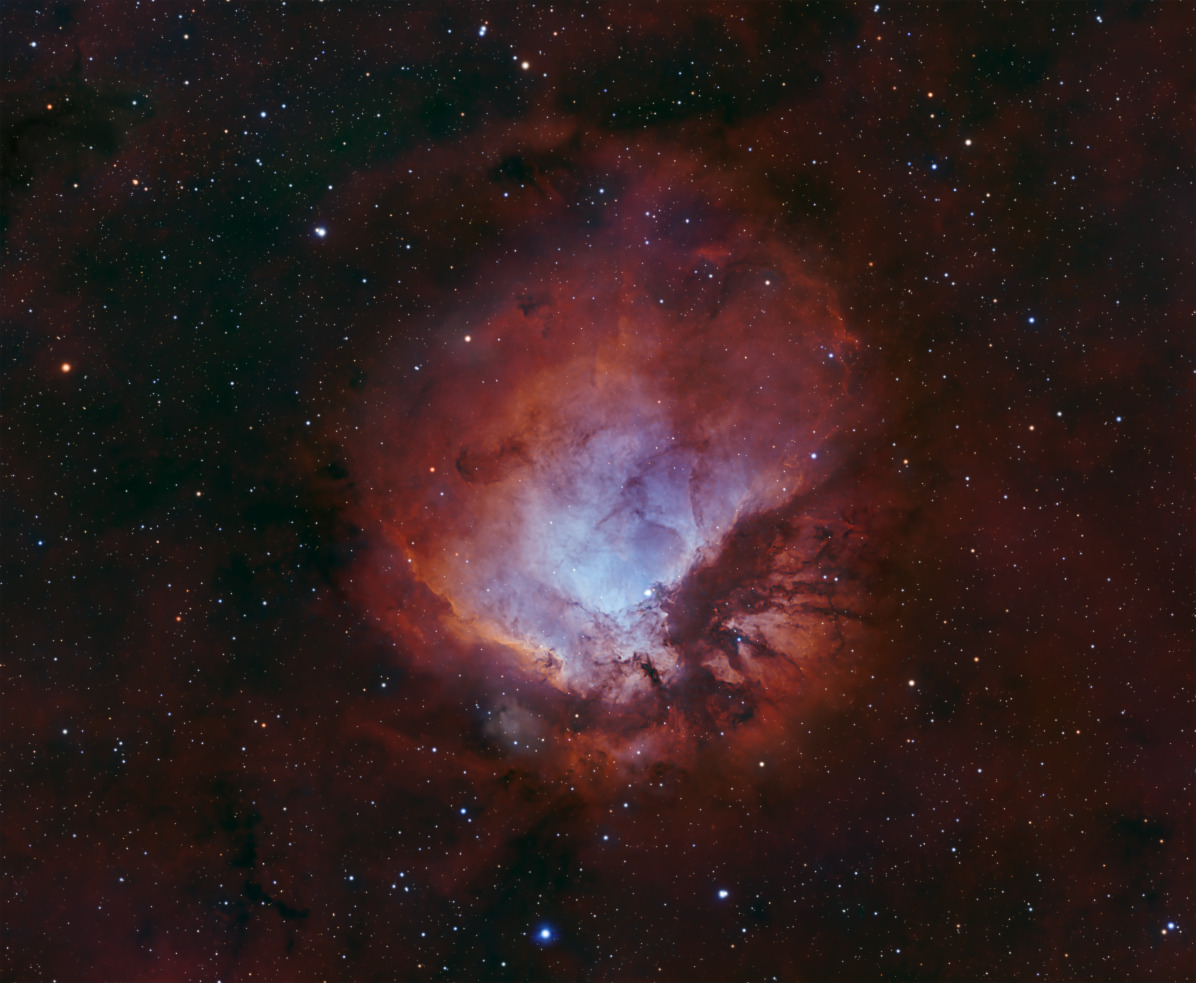
Sh2-112, DWB 174 - 175 (Nautilus Nebula)
Sh2-112, DWB 174 - 175 (Nautilus Nebula)
|
|
MOUSE-OVER
IMAGE FOR STARLESS VIEW CLICK
ON IMAGE FOR FULL SIZE VIEW (6696x5504) Scope:
Celestron 9.25 Edge HD 235 mm at f/7;
Location: DAA Observatory, Shelter Valley, CA;
Dates: 4, 7, July, 1, 2, August, 2024; Camera: ASI294MM (Baader
Ha, OIII, RGB Filters) Exposure:
Ha 104 x 3.5 minutes (gain-200 2x2), OIII 12 x 3.5 minutes (gain-200 2x2), OIII
103 x 5 minutes (gain-240 2x2), RGB - 28 each x 1.5 minutes -
(gain-121 2x2).
Processing: Data Acquisition - N.I.N.A. (as FITs). Sub-frame calibration - Pixinsight
(WBPP). Sub-frame registration and integration (Average combine -
Linear fit clipping, 2X drizzle for Ha, OIII) - PixInsight (WBPP).
Noise reduction - NoiseXTerminator (RGB, Ha, OIII) - PixInsight. Non-linear stretching for
HA, OIII -
PixInsight. RGB combine and stretching, Photometric RGB calibration (SPCC)
- PixInsight. De-convolution - BlurXTerminator (AI4) - PixInsight.
Generation of starless Ha, OIII, and RGB image for later processing -
StarXTerminator (PixInsight). RGB stars (lower stretch) for star size control - PixInsight.
Ha and OIII starless combined in HOO starless image - Pixinsight. HOO
starless screened into RGB starless (with mask) -
PixInsight. RGB stars screened into final HOO-RGB starless image -
Affinity Photo. Final finishing -
Affinity Photo. Annotation - PixInsight, Aladin (Simbad), and Affinity
Photo. This image is a Narrow Band / and RGB (starless) with
Narrow Band emphasis and RGB stars. Image processed at 8288x5644
resolution (2x drizzle stacks). Full Field image size is approximately 6400x4368.
Description: North is to the right in
this image (270°). The emission nebula, Sh2-112, dominates this field -
also known as DWB 174. A similar, but smaller area of this nebula was cataloged
LBN 337 / CED 181. This nebula complex is sometimes called the "Nautilus
Nebula" due to its appearance and features in its lower left area. This
lower left portion of the nebula complex is cataloged as DWB 175(Sh2). This
whole is known for star birth. Modern multi-wavelength studies have identified
this lower left portion as a fairly active star forming region. IR
observations in these studies identify many young stellar objects in the
mixed interstellar dust and emission in the DWB 175 region.
The structures in this image are estimated
to be about 5,600 to 6,800 light years distant.
The
red and blue emission seen in this nebula are Ha and OIII emission
(respectively). The bright star , BD+45 3216 A/B, central in the image
is the main ionization energy source for the emission. It is actually a
double star, but not resolved as such in this image since both
components have a similar magnitude
and are separated by 0.08 arc second (about a quarter pixel at full
resolution).
These objects, information, and some of the brighter
stars are identified in the annotated
image.
The Horizontal Full FOV is approximately 0.54 degrees. Full size, full field image scale is approximately
0.29 arcsec/pix.
Image
center approximately - Equatorial 2000: RA: 20h 34m 06s Dec: +45°38'20"
|
All images and content remain the property of Jim Thommes - copyright 2003 - 2025 Current
Web Total Hits -
- Unique Visitors |